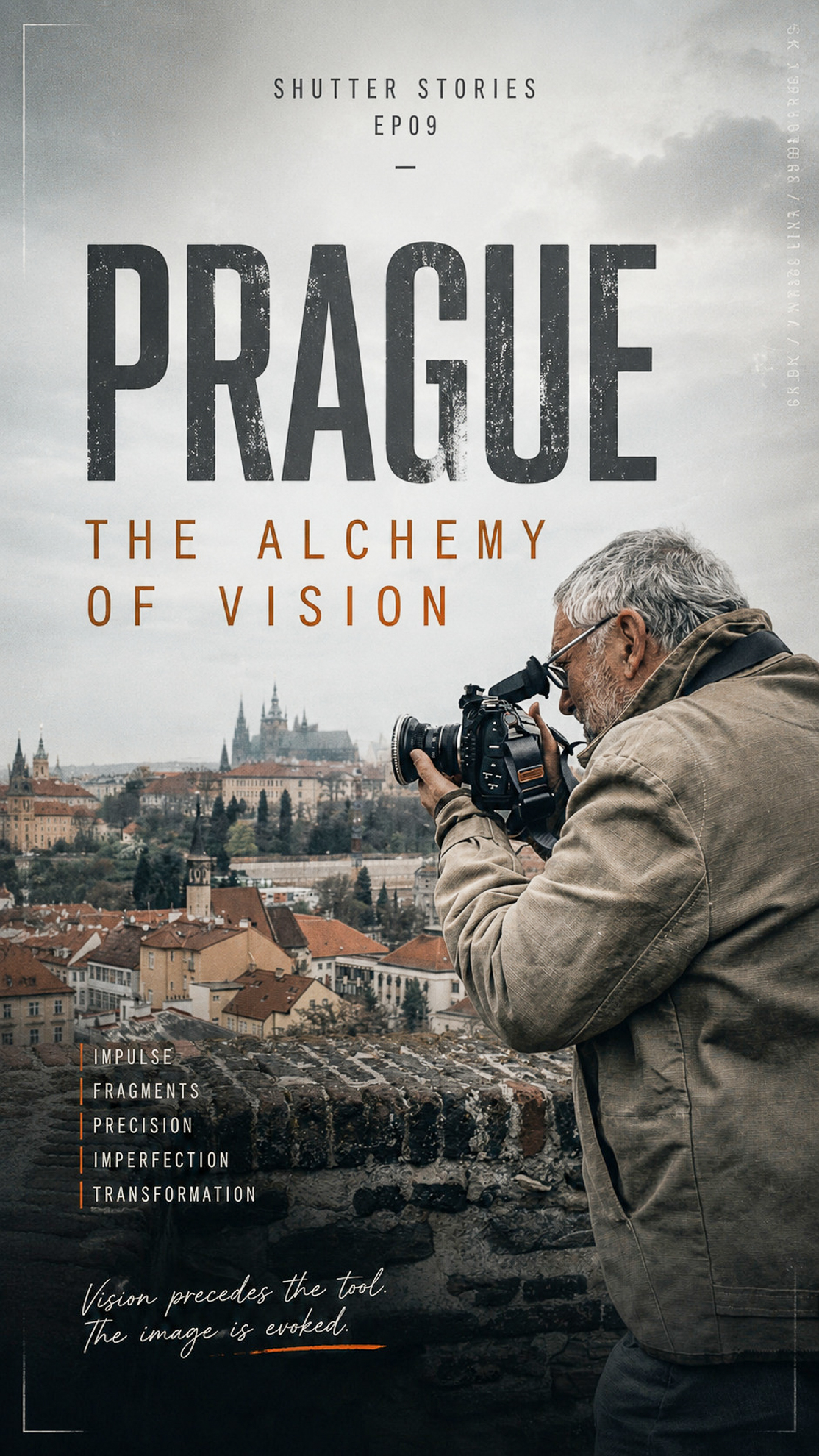
DG - THE ALCHEMY OF VISION
Notes Toward a Philosophy of Creative Becoming
URL: https://youtube.com/shorts/AUDX6FM3jeo
PRAGUE — THE ALCHEMY OF VISION | SHUTTER STORIES EP09
Prague is not a destination; it is a field of resonance. In this ninth episode of Shutter Stories, we move beyond the visual spectacle of the city to begin a stratigraphic excavation of the creative process.
Using a hybrid setup of a Blackmagic Cinema Camera 6K (BMCC6K) and a vintage Takumar lens, this film explores the tension between digital precision and analog imperfection. This is not a travel diary—it is an exploration of how vision precedes the tool.
The image does not exist in the moment of capture; it is evoked from the "messy" hybrid field of selection, distillation, and decision. We collect fragments of light, surfaces, and human gestures to impose form on the undefined weight of existence.
30 Cameras. 30 Visions. One continuous journey into the origins of seeing and the intricate mechanics of vision.
Transcript ( Voice Over )
30 cameras. 30 visions.
A continuous journey into the origins of seeing.
This time: Prague.
Where images demand action.
Not for the surface—
but for the excavation
into the creative process.
It is not about cameras.
Not analog. Not digital.
These are tools.
Extensions.
What matters is the intention behind the image—
an impulse without clear form.
Something unresolved.
Something that insists.
The ability to look deeply
is the root of creativity—
to move beyond the ordinary,
toward what remains unseen.
Vision precedes the tool.
The image is not captured—
it is evoked
from a tension between inner impulse
and external structure.
I walk. I collect.
Fragments of light, surfaces, gestures.
A 6K sensor.
A vintage lens.
Precision and imperfection—
entangled.
There is no pure process.
No clean method.
Only a hybrid field—
messy, unstable, evolving.
The image does not exist yet.
It emerges later—
through selection,
through distillation,
through decision.
This is not a travel diary.
Not documentation.
Travel becomes survival—
a way to impose form
on the undefined weight of existence.
PRAGUE — THE ALCHEMY OF VISION.
The Alchemy of Vision
Notes Toward a Philosophy of Creative Becoming
There is a threshold in every creative process where the image does not yet exist.
Not technically.
Not aesthetically.
Not even conceptually.
There is only the impulse.
A sudden, dark obsession — an unresolved longing
searching for a way to become visible.
This is the hidden territory explored in PRAGUE — THE ALCHEMY OF VISION, the ninth episode of SHUTTER STORIES. On the surface, the film appears to be about cameras, travel, analog and digital image-making. But beneath this layer lies a deeper investigation: how vision itself emerges from instability, fragmentation, movement, and lived experience.
The film rejects the mythology of tools.
“30 cameras. 30 visions.” is not a celebration of equipment. It is an attempt to dismantle the assumption that technology produces meaning. Cameras are presented as extensions rather than origins. Analog and digital are not opposing ideologies; they are simply different material languages through which perception temporarily manifests itself.
The central claim of the piece is radical in its simplicity:
Vision precedes the tool.
The image is not captured.
It is evoked.
This changes everything.
Photography or filmmaking, in this framework, is no longer documentary extraction. It becomes a form of excavation — a descent into the unstable relationship between inner impulse and external reality. Creativity emerges not from clarity, but from tension. The unresolved becomes productive.
Uncertainty becomes method.
The film therefore proposes a different understanding of artistic practice:
not as execution, but as alchemical transformation.
Travel plays a crucial role in this process. Prague is not treated as a destination or a visual spectacle. It functions instead as a field of resonance — a city through which perception reorganizes itself. Walking, drifting, observing surfaces, human gestures, fragments of light: these actions become part of a larger cognitive and emotional process.
The filmmaker becomes less a recorder of reality and more a collector of unstable fragments.
A vintage lens.
A 6K sensor.
Field recordings.
Notes.
Accidents.
Failed images.
Moments of disorientation.
Unexpected correspondences.
All of these elements enter the same hybrid field.
This is why the film insists that there is “no pure process.” Creativity is presented as fundamentally impure: layered, contradictory, unstable, constantly evolving. Analog and digital coexist. Precision and imperfection become entangled. The work emerges through accumulation, collision, and eventual distillation.
Meaning is never immediate.
The image does not fully exist in the moment of capture. It emerges later — through selection, construction, distillation, and decision. Editing therefore becomes more than technical assembly. It becomes a philosophical act: the shaping of coherence from perceptual chaos.
In this sense, the film aligns itself less with traditional cinema and more with essayistic thought. It does not tell a story in a classical narrative structure. Instead, it enacts a transformation of consciousness. The movement of the film progresses from negation, to discovery, to existential necessity.
At the beginning, surface meanings are dismantled.
Then an invisible principle emerges: deep seeing as the origin of creativity.
Finally, creation itself becomes a survival strategy.
This may be the most important idea in the entire piece.
Travel is no longer tourism.
Photography is no longer documentation.
Art is no longer self-expression alone.
Travel becomes a field of transformation.
Photography becomes a method of excavation.
Art becomes the construction of meaning from fragments.
Or slightly more cinematic/philosophical:
Travel becomes a movement through states of perception.
Photography becomes the evocation of unseen structures.
Art becomes a temporary order within chaos.
Or more existential and aligned with your VO:
Travel becomes survival through movement.
Photography becomes a dialogue between vision and reality.
Art becomes a way to impose form on existence.
This version probably synthesizes your whole theory most coherently:
Travel becomes a field of transformation.
Photography becomes the evocation of hidden relations.
Art becomes the construction of meaning through fragments.
Creation becomes the alchemical act of transforming fragments into meaning.
(Creation becomes a way to impose temporary form on the undefined weight of existence.)
The filmmaker walks through cities, archives, memories, and fragments not to preserve reality, but to construct meaning within instability. The resulting images are therefore not conclusions. They are temporary equilibria — moments where perception, memory, technology, intuition, and structure briefly align.
What emerges from THE ALCHEMY OF VISION is ultimately a philosophy of creativity grounded in process rather than certainty.
A philosophy where:
- vision matters more than apparatus
- instability becomes productive
- fragments generate structure
- hybrid methods replace purity
- perception itself becomes material
- and meaning is assembled slowly through time
The work does not attempt to explain the world completely.
It attempts something more fragile and perhaps more necessary:
to remain attentive long enough for unseen connections to reveal themselves.